


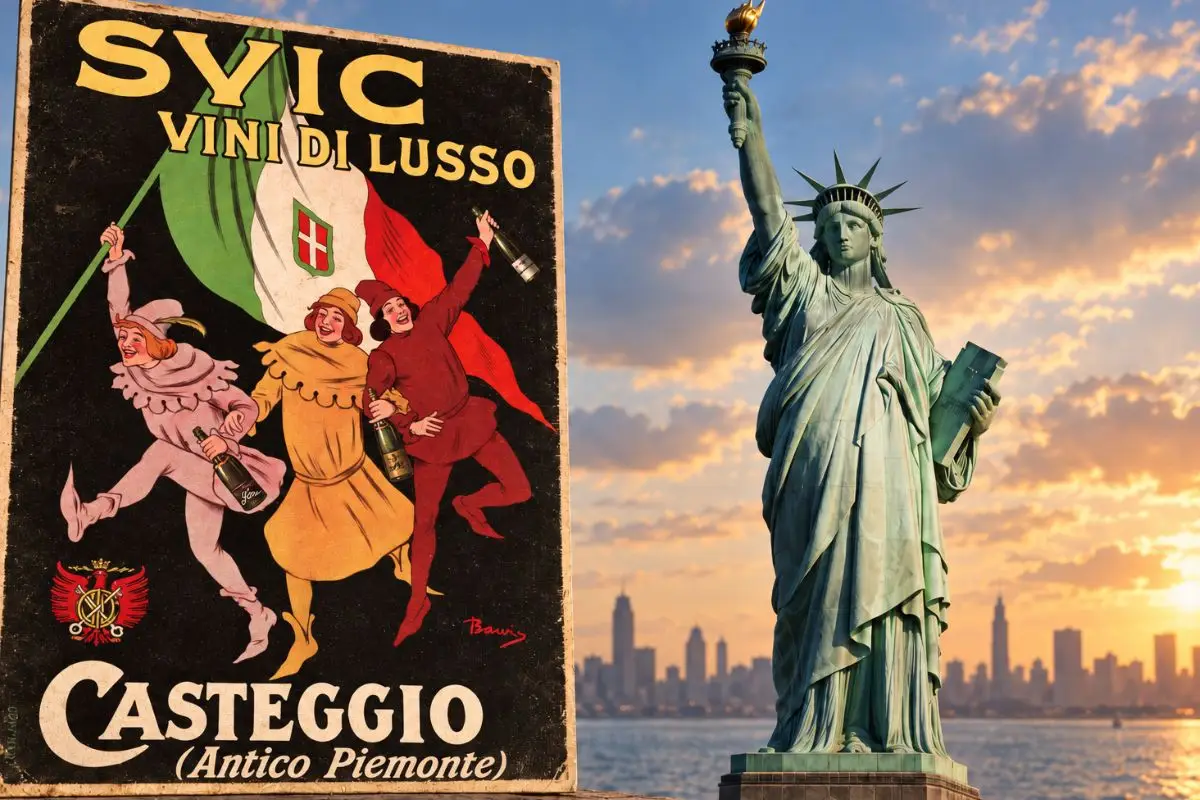
In 1912, passengers arriving in New York aboard the great ships sailing from Europe could come across a decidedly unexpected sight. Near the Statue of Liberty, a large advertising sign promoted “Gran Spumante SVIC.”
It was neither a French wine nor an American product. It came from Casteggio, in the heart of the Oltrepò Pavese.
It is a little-known story that shows how, more than a century ago, Oltrepò wine was already capable of crossing Italy’s borders and reaching one of the most iconic places in the world.
Gran Spumante SVIC from Casteggio Arrives in New York
To understand the story, we need to go back to the beginning of the twentieth century.
In 1907, the SVIC, Società Vinicola Italiana di Casteggio, was founded in Casteggio. The company was destined to become one of the leading names in the history of sparkling wine production in the Oltrepò Pavese.
The company was led by oenologist Pietro Riccadonna, regarded as an important figure in the development of modern sparkling-wine production. He was later joined by Angelo Ballabio, another name that would leave a lasting mark on the history of wine in Casteggio.
L’ambizione era evidente: produrre spumanti capaci di confrontarsi con quelli già affermati sui mercati internazionali.
E i primi risultati non tardarono ad arrivare.
From the Brussels Award to the Statue of Liberty
In 1910, SVIC received a diploma and a bronze medal at the Brussels International Exposition.
It was already an important international recognition for a company that had been founded only a few years earlier among the hills of the Oltrepò Pavese.
But what happened two years later is what makes this story truly remarkable.
In 1912, the name of Gran Spumante SVIC crossed the Atlantic.
In New York, a prominent advertising sign promoting the sparkling wine from Casteggio was installed near the Statue of Liberty, in a location visible to people arriving in the American city by sea.
Imagining that scene today helps us understand its significance.
Thousands of people were arriving in the United States from Europe. Before them stood one of the monuments that would become a universal symbol of America and, not far away, the name of a sparkling wine produced in a small town in the Oltrepò Pavese.
An Oltrepò Wine Beside a Symbol of America
At the beginning of the twentieth century, New York represented the gateway to a new life for millions of Europeans.
The Statue of Liberty was one of the first major landmarks seen by those reaching the city after crossing the Atlantic.
It was in this setting that SVIC’s advertisement appeared.
Le fonti storiche legate alla viticoltura oltrepadana ricordano inoltre il particolare valore emotivo che quell’immagine poteva avere per gli emigranti provenienti dall’Oltrepò e più in generale dall’Italia: dall’altra parte dell’oceano potevano ritrovare il nome di un prodotto nato nella loro terra.
It was therefore not simply an unusual advertising campaign. It was also evidence of how local wine companies had already developed the ability to look towards extremely distant markets at a time when exporting a product from the Oltrepò to the United States was certainly far more complex than it is today.
Casteggio Was Already an Important Wine Centre
SVIC was not founded in Casteggio by chance.
Between the end of the nineteenth century and the first decades of the twentieth century, the Oltrepò Pavese was developing a distinctive identity in the world of sparkling wine.
Pinot Noir, which would go on to become one of the region’s signature grape varieties, had found particularly favourable growing conditions in the hills of the Oltrepò Pavese. At the same time, new companies, wineries and more organised forms of production were emerging.
Casteggio played an important role in this period of development.
According to historical accounts, SVIC was not simply a small local winery. During the early twentieth century, it came to manage several production facilities and marketed wines and sparkling wines abroad as well.
Some products were specifically designed for the American market.
It is within this context that the advertisement for Gran Spumante SVIC in New York takes on even greater significance: it was not an isolated episode, but the visible symbol of an international commercial strategy that was already surprisingly advanced.
A Story That Reveals a Different Side of the Oltrepò
Today, we are accustomed to associating the Oltrepò Pavese with vineyards, wineries and traditional-method sparkling wines.
What is far more difficult to imagine is that, more than one hundred years ago, a product made in Casteggio was being advertised in one of the most famous locations in New York.
And yet, that is exactly what happened.
The story of SVIC reveals a lesser-known side of the Oltrepò: a region capable not only of producing wine, but also of developing winemaking expertise, building businesses and seeking international markets at the very beginning of the twentieth century.
Long before social media campaigns, digital marketing and wine tourism, someone had already decided that a sparkling wine from Casteggio should become known on the other side of the ocean.
And they chose a place that was difficult to ignore.
From the Oltrepò Pavese to New York, More Than a Century Ago
More than 110 years have passed since that 1912.
The New York of that time no longer exists, and the world of wine has also changed profoundly. Yet that advertisement remains a small episode capable of telling a much larger story.
Today, when we look at the vineyards surrounding Casteggio, it is easy to think about the agricultural history of the area.
Molto meno immediato è pensare che da quelle stesse colline, già all’inizio del Novecento, partivano bottiglie destinate agli Stati Uniti.
And that, for people arriving in New York by sea, the name Casteggio could appear right there, beside the Statue of Liberty.